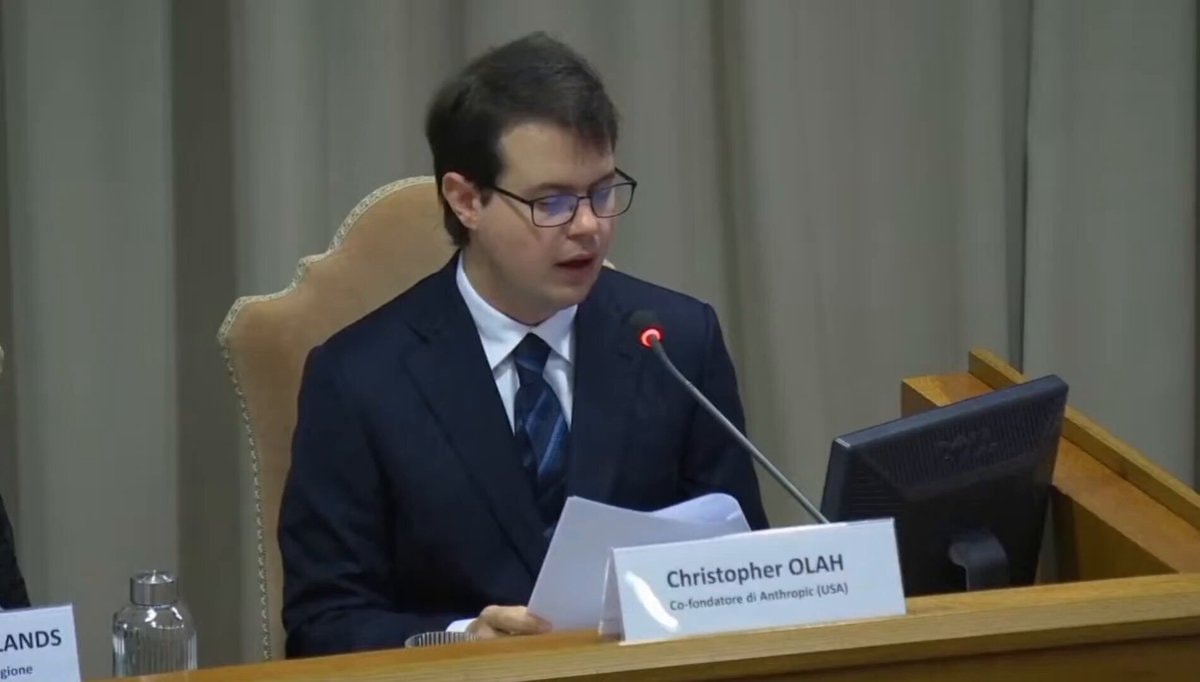
Christopher Olah Anthropic Pope Leo XIV
yazan Tim Official: Chris Olah
Anthropic has drawn the Pope into its fight against the Pentagon. Yesterday Pope Leo XIV released a 245-paragraph document that calls for AI companies to be disarmed and demands a permanent ban on autonomous weapons. He likened the unchecked drive of Silicon Valley to the Tower of Babel and described the labor conditions behind much of AI progress as new forms of slavery. While many shared the news, few observed the notable figure seated beside him. Christopher Olah, co-founder of Anthropic, sat in a row of cardinals at the Vatican and helped present the document with the Pope. A 33-year-old atheist tech billionaire stood next to the leader of 1.4 billion Catholics to declare that AI weapons must be halted. This development carries weight because of an ongoing courtroom battle. Anthropic has been engaged in a legal conflict with the Trump administration since February. The Pentagon placed the company on a blacklist as a supply chain risk to national security after Anthropic declined to allow its AI to be used for fully autonomous weapons and mass surveillance of American citizens. That label is typically applied to firms connected to adversaries such as China and Russia. Yet it was used against an American firm simply because the firm refused. The Trump administration labeled Anthropic liberal-leaning and claimed it was attempting to set military policy. Defense Secretary Pete Hegseth signed the blacklist order himself, and Trump instructed all federal agencies to cease using Anthropic technology. More than 100 enterprise customers contacted Anthropic to ask whether they could safely continue working with the firm. The company projects that the government measures may result in several billion dollars of lost revenue in 2026. Anthropic responded by filing two separate lawsuits in two different courts. A judge in San Francisco decided in its favor and halted the supply chain designation, but the DC appeals court ruled the other way. The conflicting decisions currently stand in direct opposition. Several days ago the DC appeals court held oral arguments, during which the judges appeared split. On May 25 the Pope issued a document that aligns precisely with Anthropic's legal stance on autonomous weapons, matching it nearly word for word. The Pope stated it is not permissible to entrust lethal or otherwise irreversible decisions to artificial systems. That phrasing closely mirrors the language Anthropic included in the Pentagon contract that triggered the dispute. Christopher Olah also addressed the audience at the Vatican event. He remarked that every frontier AI lab functions within incentives that can at times clash with doing the right thing and urged the need for moral voices that those incentives cannot bend. A co-founder of an AI company openly acknowledged at the Vatican that AI firms cannot be relied upon to regulate themselves. This amounts to a deliberate legal approach by Anthropic. The firm now possesses endorsement from the world's most influential moral authority for the precise ethical boundaries that prompted the Pentagon to penalize it. Every judge considering the case has seen the Pope affirm the two limits Anthropic established. The Pope's encyclical is almost certain to appear in upcoming court filings. The Pentagon maintains that a private company cannot prescribe how the government applies AI in areas tied to national security. Anthropic counters that some applications of AI remain inherently unethical no matter who deploys them. Yesterday the Pope informed 1.4 billion people that Anthropic is correct. The appeals court may issue its decision at any moment. Should Anthropic prevail, every AI company worldwide would gain legal precedent allowing it to turn down military contracts for ethical reasons. If it fails, the signal sent to Silicon Valley would be unmistakable: develop whatever the government orders or face elimination. In either outcome, the company the Trump administration sought to dismantle has now secured the Vatican as an ally.
Metin dökümü (en)
I wish to name three questions where I think the church's voice is especially needed. The first is our duty to the global poor. There is a real possibility that AI will displace human labor at a very large scale. If that happens, supporting those displaced will be a moral imperative of historic proportions. This task will be difficult enough, but I worry most dialogue misses an even harder challenge. AI development is concentrated in a handful of wealthy nations. How will we ensure that the gains of AI are shared globally? We do not have a mechanism for this. It is an unsolved problem. And it is the kind of problem the church has historically refused to let the world ignore. The second is the need for moral imagination and ambition regarding human flourishing. If AI models are going to be widespread, what does it look like for humans, families, and the world to flourish? Today, parents are already worried about their children's minds, individuals about the future of their work. These are not questions a lab can answer. But they are questions traditions like yours have carried for millennia. And we need you to keep carrying them into this new moment in history. The third is the need for discernment on the nature of AI models I am a scientist I lead a research team that studies the internal structure of these models What is actually happening inside them? And I will be honest, we keep finding things that are mysterious, even unsettling. We find structures that mirror results from human neuroscience. We find evidence of introspection. We find internal states that functionally mirror joy, satisfaction, fear, grief, and unease. I don't know that means but I think it warrants ongoing discernment. I'd like to close with a request. We need more of the world, religious communities, civil society, scholars, governments, and indeed all people of goodwill to do what his holiness has done here. To take seriously, to look closely, and to push events in a better direction. We need informed critics who will tell the labs when we are failing. We need moral voices that the incentives cannot bend. Today is just the beginning, The start of a long collaboration between those of us who are building this, and those who can see what we, from the inside, cannot. Today is a powerful illustration of the form this global project of goodwill might take. Let it also be a decisive step towards a hopeful future for a magnificent humanity. Thank you.