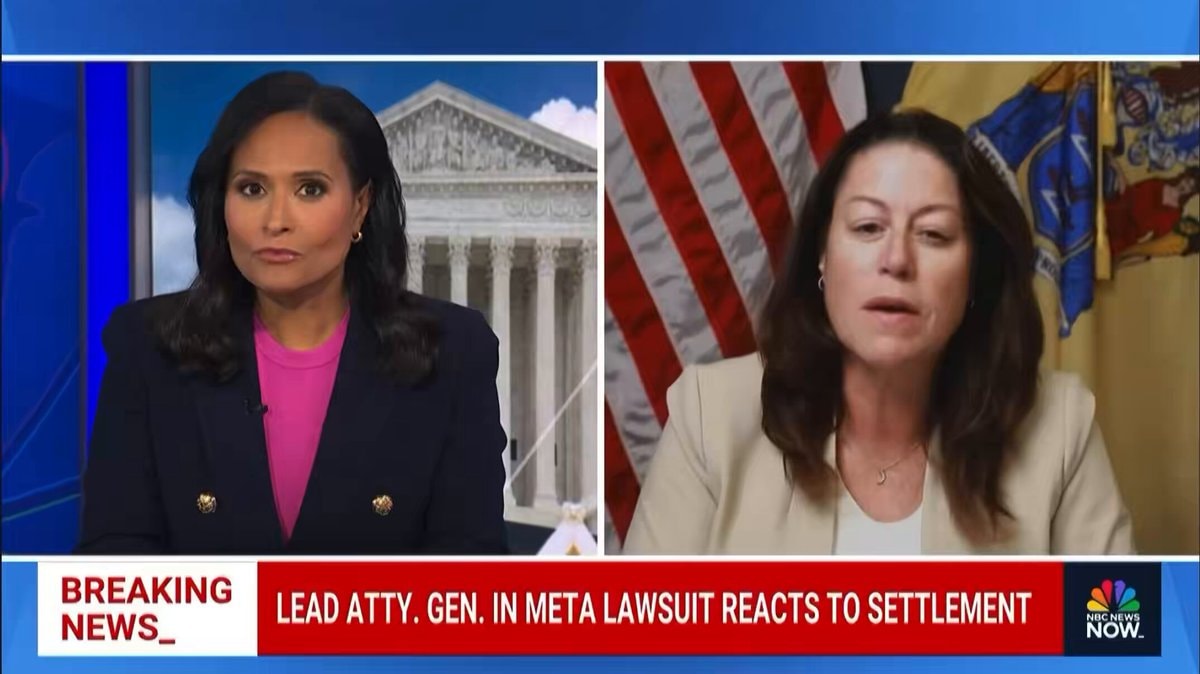
Meta settles lawsuit for $16.68 billion
yazan Tim Official: Meta
Meta just paid the largest settlement in history and its stock went up. This morning, Meta agreed to pay a maximum of $16.68 billion to settle claims from 29 state attorneys general that it designed Facebook and Instagram to addict children, misled the public about their safety, and collected data on kids under 13 without parental consent. Meta denied wrongdoing. And investors celebrated. To understand why, you need the number Meta itself put in front of the court: In pretrial filings, Meta warned that the states' own damages framework could theoretically produce penalties as high as $1.4 TRILLION. The states' own lawyers signaled that roughly $200 billion was the realistic target at trial. But they settled at $16.68 billion. For context: Meta earned $60.46 billion in profit on $200.97 billion in revenue last year. The settlement works out to about 27% of a single year's profit and 8% of annual revenue. Zuckerberg's company ended June sitting on $90.26 billion in cash and marketable securities, and it just raised this year's capital spending guidance to as much as $145 billion. But the timing is what's really interesting here… The trial opened in Oakland on August 18 and was scheduled to run six weeks. It ended in week two. Adam Mosseri, the head of Instagram, was questioned on the stand on Tuesday. The settlement landed Wednesday morning. Mark Zuckerberg literally never testified. Child safety advocates had waited years to watch him take that stand, and now he never will. Those four remaining weeks were where the internal documents get read into the record. California's deputy attorney general opened the whole case like this back then: "What you're going to hear in this trial is how Meta hooked kids on its platforms. How it designed those platforms so that kids kept coming back." The states alleged that Meta buried its own research showing children were being harmed. A judge had already ruled that Meta's lawyers tried to block internal teen harm research from surfacing, which Meta disputes. One Meta employee wrote in 2021: "No one wakes up thinking they want to maximize the number of times they open Instagram that day. But that's exactly what our product teams are trying to do." Settling ends the trial. And ending the trial ends the disclosure. Now look at what Meta actually agreed to change: Night mode blocking access between midnight and 6am, a default two hour daily limit, no notifications during school hours, a prompt after every 15 minutes of continuous use, hidden like counts, and no cosmetic surgery or makeup filters. Every one of those is a product setting Meta already controls. So 52 attorneys general signed a term sheet negotiated with the defendant rather than passing a law that would outlive it. Then Meta did something genuinely genius: The company publicly called on TikTok and YouTube to commit to the same standards, arguing that reform won't work unless the whole industry lines up together. Meta has already absorbed that cost. But its competitors haven't. Axios called this social media's version of the 1998 tobacco settlement. Under that deal, states collected more than $200 billion. Every other platform in America just watched this happen. They now know the number, they know the timing, and they know that a settlement buys the silence of the evidence. This is a win for Meta.